
Problems require solutions. Solutions require decisions. And decisions are often the furthest thing from easy.
Why do people struggle with decisions? Many are tempted to blame a lack of information. Therefore, they go back to the data again and again, searching for answers it can’t provide.
Decision-making isn’t about waiting for the data to reveal the answer. Effective decision making is about understanding the three-part alchemy. It happens when time, risk, and trust (TRT), blended in the right mix, leads to a clear outcome. So, part of the answer to “Why do people struggle with decisions?” is the recipe is always changing depending on the moment. That is why meaningful decisions are rarely easy. Data is only one ingredient. TRT occupy three other spots. Smart decision-makers adapt their input to the moment. Situational decision-making uses intuition and experience to look through these three lenses to chart a clear path forward.
The goal isn’t a perfect decision. The perfect decision does not exist. It’s about making a confident decision to enable you to move forward. That starts with understanding what’s shaping the decision moment.
What Really Governs Decisions
Time, risk, and trust. We process these factors subconsciously throughout the dozens of decisions we make every day. But let’s dig a bit deeper. While they might be out of your control, these three components can still be measured, giving you a playbook for how to respond to their influence on a decision you need to make.
Let’s start by defining each component.
Time is the most straightforward. Of course, a short time frame will constrain data, discovery, and discussion. We’ve all felt the pressure of a ticking clock, but more time isn’t always better. A long runway might seem advantageous, but it can come with steeper opportunity costs. What aren’t you doing while you’re busy deciding? Delaying or not deciding is a decision.
Then, there’s risk both at the situational level and over the long term. Risk is a critical concept in the decision paradigm at it has a large influence on the individual. Humans are often loss-averse, meaning they fear losses more than they appreciate gains. This mindset known as ‘loss aversion’ is a foundational concept in behavioral economics, first identified by Kahneman and Tversky in 1979. It refers to the tendency for humans to prefer avoiding losses over acquiring equivalent gains.
Trust is the final dimension. How much do you trust the information you’re using to make the decision? How much do you trust the analysis or modeling? How much do you trust the team sharing the data? This is where intuition comes in. Knowing whether the data and the people responsible for delivering it are capable and trustworthy depends as much on instinct as it does on experience. For how to develop this kind of intuition, read my previous article on the power of approximation.
How Three Factors Influence Your Decision
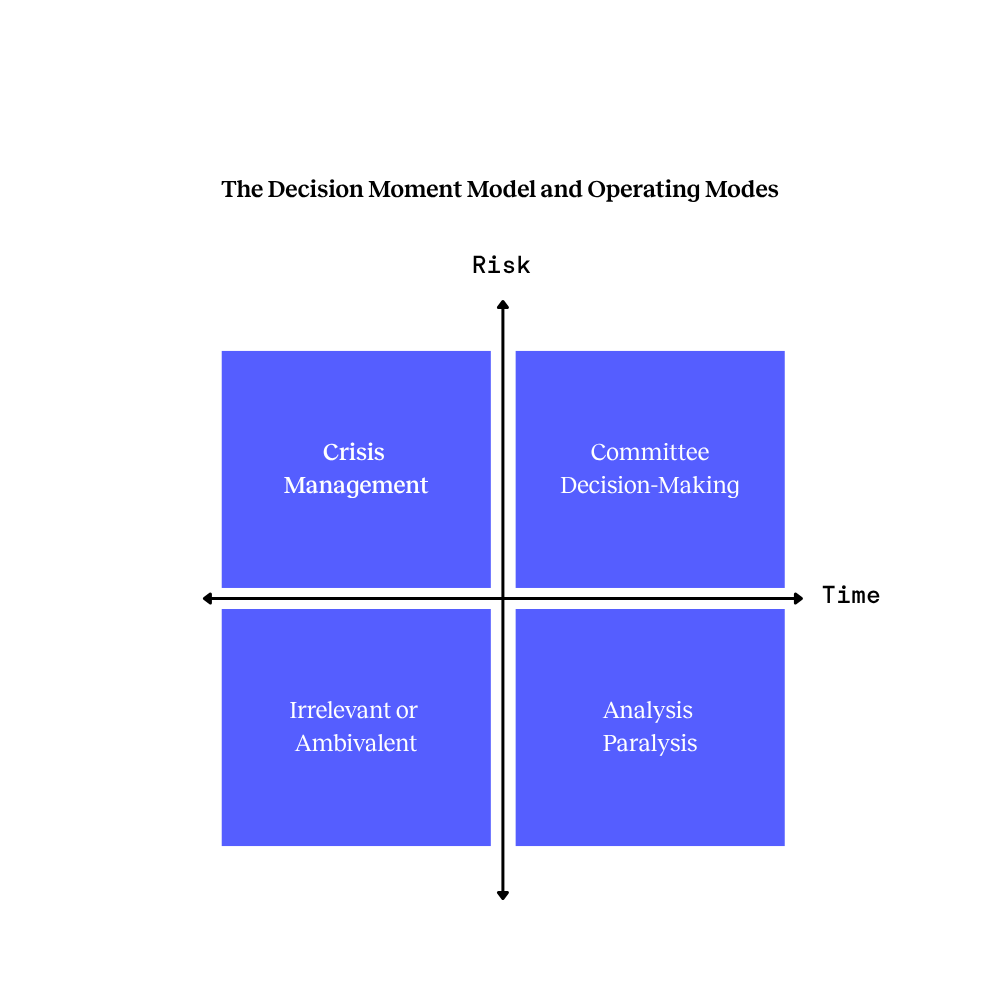
Let’s start with risk (y-axis). Risk can either be high or low. What about when risk remains low, but time (x-axis) is unbounded (bottom right quadrant)? The flexible nature of this situation might feel like a relief, but it can just as easily lead to quagmire. Analyzing and re-analyzing every possible solution doesn’t result in decisive action. It results in paralysis. You’re stuck in a loop while opportunities pass by. Recall: no decision is still a decision.
When it comes to scenarios that carry high risk but allow for plenty of time (top right quadrant), you’re likely looking at decision via committee. This is the domain of large organizations, governments, and even families. Since the risk is high, you need to carefully consider the decisions, but lack of a time constraint means a lot of work, multiple voices and minimal action. Most stakeholders will enter the discussion as lobbyists for their personal conviction, but they may be able to be swayed to consider alternatives. When this occurs, the permutations spiral out of control, as the timeline is long.
Finally, there are situations when risk is high but time is short (top left quadrant). These factors usually align when there’s a crisis. It’s easy to understand the costs of indecision and wrong decisions in these moments. That’s why those who frequently face these circumstances train and specialize. In business world, it could be a product crisis, a media issue, or a brand sponsorship gone sideways. In non-business situations, think emergency medical personnel or troops on a battlefield. These professionals train for high-stress environments and sharpen specific skills to function seamlessly as part of a team. They’re generally part of a hierarchical organization that doesn’t deliberate—it just acts.
Decision making is a team sport, and team members should feel empowered to voice their opinions. Nonetheless, this sort of highly-trained, coordinated teamwork is something to aspire to, and it will improve decision-making in any of the contexts I’ve discussed above.
So, when you need to make a decision, while data is essential, overtly discussing time, risk, and trust will advance your team’s decision-making ability.
Measuring Decision Dimensions
How can you measure time, risk, and trust? To start, don’t think of these factors in exacting, empirical terms. Important decisions rarely come down to just math equations. Decision-making is an art, and these three factors should be balanced through both quantitative skills and intuition.
Allocating Time
Effective time boundaries are critical, and they should be discussed with stakeholders up front to set expectations. For time, “T-shirt sizing” into hours, days, or weeks can be helpful here. Like I discussed under the graphic above, the decision type dictates the time required. Effective team members can keep things moving on schedule by pre-assembling all the necessary decision-making components for stakeholders, like a chef uses mise en place to prepare ingredients for a dish.
While it’s important to be efficient with time, don’t cut corners by excluding a diverse range of voices in the process. Gaining perspectives across disciplines will help to avoid blind spots, and reinforcing the views of a homogenous group is simply a waste.
Measuring Risk
When it comes to risk, no single measurement can tell the full story. But you can recognize some boundaries with rudimentary, but insightful techniques. The Apgar score for evaluating the health of a newborn was designed by a professor of anesthesiology on a scrap piece of paper. It’s a straightforward rating on a handful of basic health factors, but it’s rapid, convenient, and makes sure doctors and nurses take the most important ones into account.
The BANT (Budget, Authority, Needs, Timeline) model devised by IBM, or Hubspot’s updated GPCT (Goals, Plans, Challenges, Timeline) work similarly by establishing only the most critical elements of risk as a jumping-off point for quick approximation.
Evaluating Trust
Every decision is different, and past performance is rarely a predictor of future results. That means trust is impossible to put on a rating scale. Evaluating trust is again, a function of instinct and experience. Keep in mind too the values and decision processes of individuals seeking your trust when you’re reviewing their recommendations. As Deloitte’s framework of Business Chemistry Types lays out, while some team members are naturally “Pioneers” who value creative possibilities and big risks, others tend to be “Guardians” who prioritize stability and deliberate decision-making.
Full Sail Ahead
Decision-makers would love the comfort of feeling that no options are ever really eliminated. But that’s not the world we live in. That kind of wishful thinking only belabors the inevitable while wasting time and money. As does a roulette approach of spreading your bets around the table without really committing to one path. Don’t launch a fleet of sailboats hoping one reaches the ideal destination. Instead, try launching one full sail and correcting course as necessary.
Amazon suggests looking at decisions as either One-Way or Two-Way doors. While the former includes decisions that are not easily reversed, the latter has limited consequences that can be more undone over time. Years ago when he was at IBM, my co-author Paul Magnone declined an opportunity to partner with an electronic election system company. Getting into the controversial, politically-charged arena of elections was too great a risk for the IBM brand. When reputations are on the line, decisions often come with one-way doors.
Still, true one-way decisions are rare. The problem is that people tend to treat the nature of every “big” decision they’ll make as a one-way door. This is paralyzing.
In reality, going straight from Point A to Point B is usually a mistake unless you can’t avoid it. Sailboats can’t sail directly into the wind. They tack instead, making a series of measured turns and course corrections to reach their destination. You can do the same with important decisions by breaking them down into a series of micro-decisions that can be easily adjusted along the way.
Sir Richard Branson did this when he convinced investors to support Virgin Airlines only because Boeing agreed to take back Virgin’s single 747 jet if the business wasn’t performing after a year. The business’s potential failure wouldn’t squeeze investors past a point of no return. They would have an opportunity to recover their resources and keep moving.
Building Your Decision–Making Skill
Effective decision-makers don’t chase easy choices. They practice situational decision-making. They recognize each decision is unique. They pause up front to define the decision via time, risk, and trust. They then bring in the appropriate functions, skills, and expertise to match the moment. They expect the recipe to shift. As new information comes in, they retain the right to be smarter tomorrow. They adjust, but they move forward. They do not wait for the perfect decision. And like all great chefs, they know that the best results come from a mix of science, intuition, and art.
Let’s talk about how you and your customers make decisions. Get in touch with me at cfrank@psbinsights.com