

A wise headmaster once told his plucky young pupil: “It is our choices…that show who we truly are, far more than our abilities.”
That was Albus Dumbledore, reassuring a young Harry Potter after his showdown in the Chamber of Secrets. And while business has little in common with vanquishing dark lords (depending on who you ask), the message rings true. Choices matter. A lot. As people and as organizations, they define us.
But there’s a catch. You can develop the ability to make smarter decisions with incomplete information, confidently, consistently, and systematically. That’s why in Decisions Over Decimals, we share an approach called Quantitative Intuition™ (QI), based on practical, front-line experience with global companies.
I’ve written previously about the first two parts of this process—powerful questions to effectively frame problems, and the required skill of contextual analysis. In this post, I tackle the third and final piece of QI: synthesis.
Synthesis Over Summary
Summary is data that has been organized. Synthesis is data plus judgement. It’s the critical bridge between analysis and action. But action tends to be elusive in spite in the information-rich world we swim in today.
You’ve asked the right questions. You’ve collected the right data. You’ve presented it in beautiful slides. Still—limited action. People hand-wring over the decision. The debate continues with no end in sight. Maybe a decision gets made, but it doesn’t stick past the meeting. People walk it back.
You ask yourself: How could that be? I talked to hundreds of customers, I have thousands of data points. I ran driver analysis, advanced modelling. I used AI agents to tell a compelling narrative. I even resorted to using 8-point font since I had so much data! What am I missing?
Summarizing your findings won’t move you closer. And yet, for a variety of reasons, many stop at summary before taking the step to synthesis. Before adding their judgement.
Here’s why summary doesn’t help you make smarter decisions.
Imagine heading to the doctor after falling ill. They ask some questions and do some tests. Then they summarize: “Well, you have a runny nose, a swollen throat, and a high fever,” before ending the appointment and walking out of the room. Not very helpful.
Synthesis is a diagnosis. It’s what happens when you take all the relevant facts and combine them with judgement and context to zero in on an explanation. A good doctor doesn’t just list off the data on your chart. They synthesize it with years of training and experience to tell you, “You have the flu. Take this medication, get plenty of rest, and you’ll feel better soon.”
Defined simply, synthesis is the process of taking pieces of information, connecting them to one another, to the environment, and adding judgement. However, adding judgement can be easier said than done for researchers who are used to certainty.
Why Adding Judgement is Hard
Market researchers are trained to believe that objectivity is the gold standard. Their professional identity is built around the idea that data speaks for itself; that numbers are neutral and therefore trustworthy. Injecting judgment feels like contaminating the data. The hesitation reflects a deep professional value that has been somewhat distorted.
Where the Reluctance Comes From
Being wrong in a visible way. Data gives cover. If a decision fails, you can point to the numbers. But if you added your own interpretation and the recommendation fails, you failed. Judgment creates accountability that raw data doesn’t.
Anxiety of client pushback. There’s a real fear that clients will push back on opinions—and sometimes they do. Researchers want to be seen as truth-tellers, and they think that saying, “the data shows X” gets less resistance than “I believe X because of the data.” So they suppress the interpretive, humanistic side of the work and develop the inclination to minimize judgment.
Overstepping their role. Many analysts genuinely feel that interpretation belongs to the strategist or the client, not to them. They see their job as delivering clean inputs to the decision discussion.
The Culture Problem
The research craft self-selects a certain kind of person who is analytically rigorous, methodologically cautious, and skeptical of anecdote. These are important qualities, but they can become limiting when researchers treat uncertainty as negative rather than something to reason through carefully. Instead of embracing the outliers in the data, we’re tempted to relegate them to the appendix. When the results are surprising, we sometimes prefer a quick explanation instead of a trip down the rabbit hole.
But surprises can be profitable. They are the rocket fuel of disruptive models, innovative products and challenger brands.
Researchers can also conflate personal opinion (which is rightly excluded) with informed professional judgment (which is the whole point of hiring an expert). A doctor reading a scan isn’t “contaminating” the data by interpreting it. That is the value they provide. Market researchers need to give themselves permission to play that same role.
The Irony
“Letting the raw data speak for itself” is still a judgement call. And it’s usually a mistake. Raw data doesn’t mean anything without context, framing, and interpretation. The best analysts understand that rigor and judgment aren’t opposites. Judgment is how you know which rigorous methods to apply to extract meaning for decision-makers.
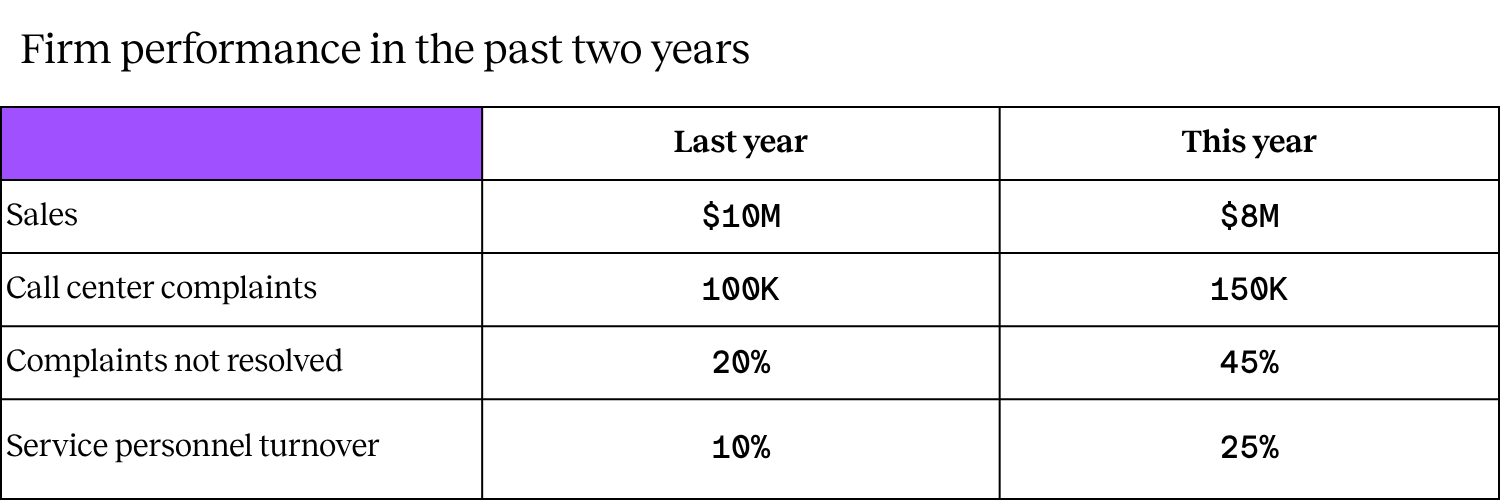
Let’s talk about synthesis in a business context using the figures in the table above.
The meeting starts and the mood is grim. The analyst begins: “Sales dropped 20%. Complaints to the call center increased by 50K. Twenty-five percent of them weren’t resolved. Fifteen percent of our service personnel turned over.”
Everyone can see the table for themselves. The analyst’s recitation doesn’t move the discussion forward. A mid-level manager offers, “High turnover in the service department likely deteriorated our overall service quality. That may have been why sales suffered.”
A reasonable-sounding synthesis. But the call center manager chimes in: “Maybe it’s not a personnel retention problem, but a problem with the product. Customers are flooding our support lines with complaints about it being faulty. Unfortunately, my agents have no way of resolving their issues. Many of them became frustrated with this situation—that’s why they left.”
Each explanation, or neither, could be true. But both pushed the dialogue ahead. Others sitting around the table were inspired by the two managers’ exchange and offered syntheses of their own, like the effect of a recent price increase or change in consumer preferences. The colleagues now had several possible explanations to pour judgement and context on, bringing them closer to fixing the problem.
Make the Bottom Line the Top Line
In a decision-making context, don’t bury the lead. Start with reporting the decision, or the implications of your analysis, and follow with the supporting facts. Make your recommendation the title of the slide and the lead of the first paragraph on the page.
This is known as the Inverted Pyramid style presentation, and it contrasts with the chronological narrative style that many are used to.
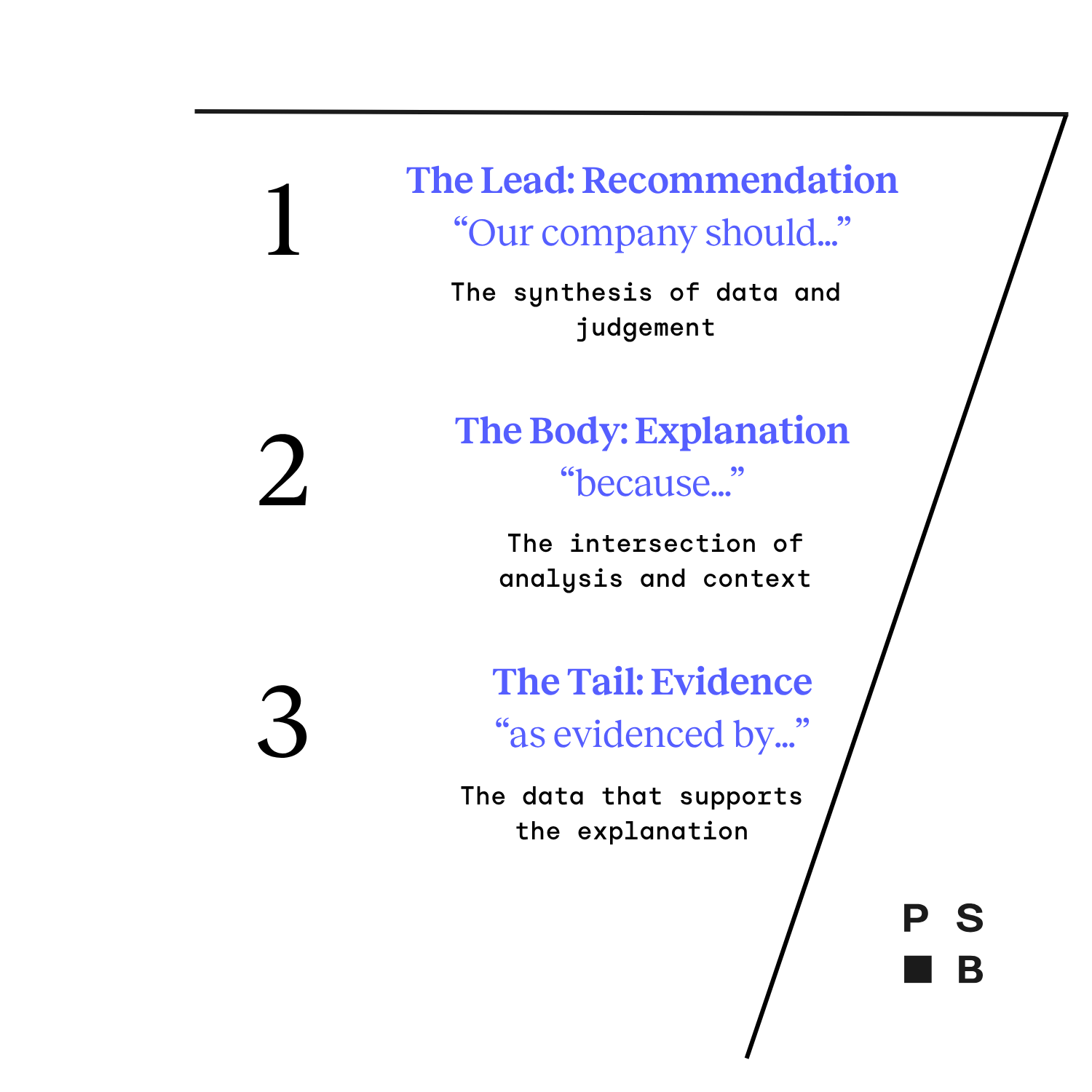
The process that gets you to your recommendation can and should involve a bottom-up analysis of the insights building toward a conclusion. But it’s less effective to communicate it that way to audiences.
Let’s face it: people have short attention spans, and you’re more likely to catch them while you have them. A good synthesizer starts with “what” they’re recommending and follows up with “why” to head off distracting concerns about the process that can diminish trust in the end product.
The Role Great Leaders Can Play
Leaders should empower team members to synthesize. Even if the syntheses happen to be wrong, they’re building the confidence and muscles to do it better next time. Helping early-career employees understand that judgement is just one factor in a decision, not the decision itself, gives them more confidence to take the risk. You can foster this behavior by encouraging employees to not just report problems but rather report them with multiple potential solutions. Give them the permission to make erroneous judgements and support taking calculated risks.
“So What?”
Synthesis powers the transition from analysis to the next essential questions in a decision-making process: “So what?” and “What are we going to do about it?” This is the part where the doctor uses their diagnosis to prescribe a remedy.
We trust the doctor to act confidently and decisively. When it comes to answering critical business questions, we can struggle to trust ourselves. The uncertainly overwhelms, and we get stuck treading the waters of endless data points and analyses. But problems don’t get fixed without proper treatment. Steps like synthesis are so important because they keep the decision-making process moving, getting us closer to a result. And certainty? It’s a myth. Outcomes are not guaranteed, so focus on what you can control: the confidence to make smart decisions with limited information.
Let’s talk more about how you and your customers make decisions. Get in touch with me—cfrank@psbinsights.com