

With data collection now available at the press of a button, it can feel like we’re drowning in information but starving for insights.
That meticulously crafted dashboard on your screen? It represents 20% of your data story. The other 80%— hidden in customer conversations, social media comments, and support tickets—contains the ‘ah-ha’ moments that could transform your business. While most market research organizations continue to overlook this goldmine of intelligence, forward-thinking leaders are discovering competitive advantages in places their rivals aren’t even looking.
Navigating the Complete Data Ecosystem
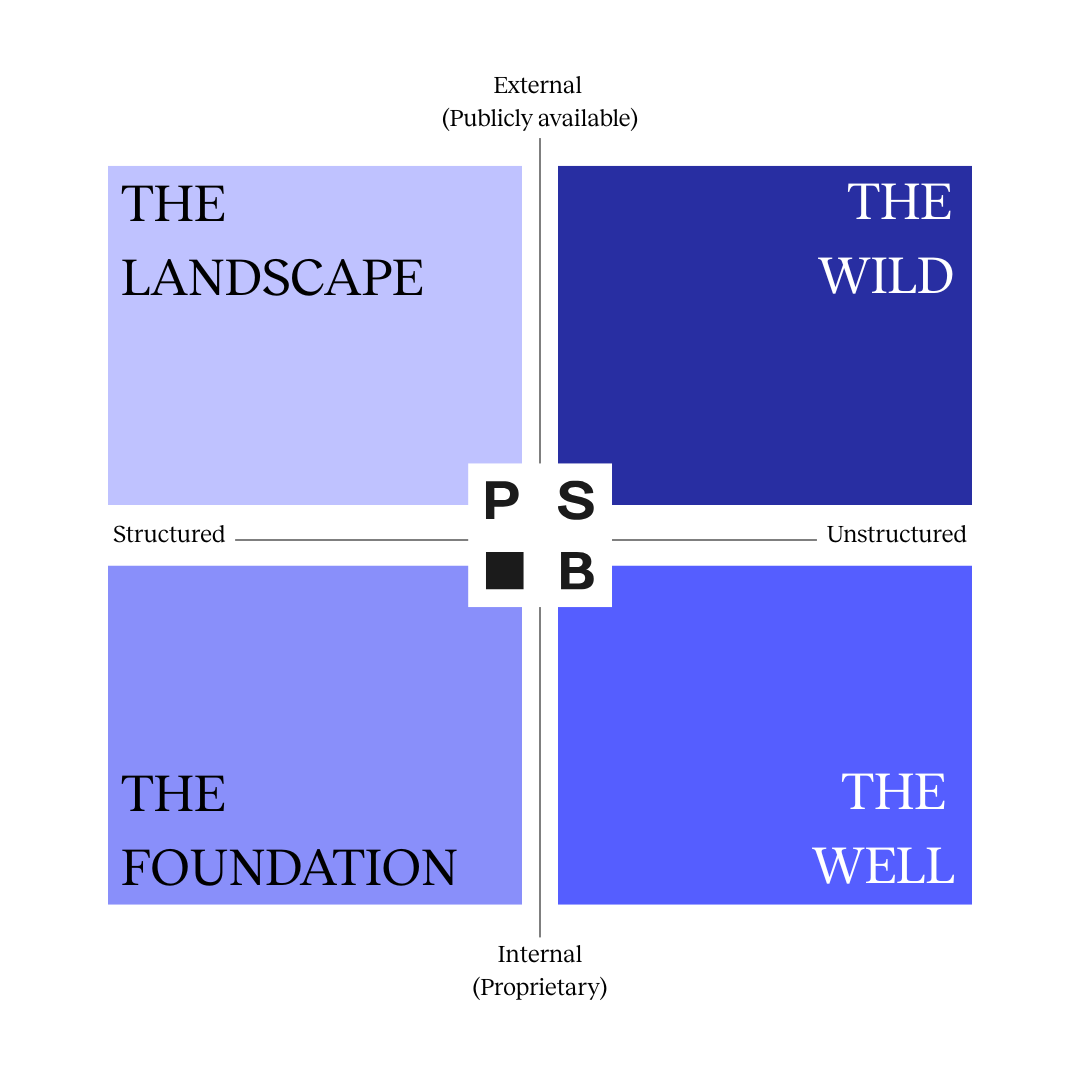
Every organization sits on a treasure trove of insights distributed across four distinct but complementary data territories. Understanding all four is essential for informed decision-making with a complete perspective. Here’s how to think about each of them.
Structured Data: Familiar Territory
The Landscape (External)
What it is: Traditional market intelligence, such as:
- Market share reports and competitive analysis
- Industry benchmark studies and economic indicators
- Third-party research and syndicated data
What it offers: Context and comparative frameworks that help you understand your position in the broader market ecosystem.
What it lacks: The “why.” External structured data reveals what happened, but rarely why it happened—and by the time trends appear in these metrics, forward-thinking competitors have already spotted and acted on them elsewhere.
The Foundation (Internal)
What it is: Metrics obtained through proprietary, primary research, such as:
- KPIs, NPS/CSAT scores, and sales metrics
- Customer demographics and transaction data
- Campaign performance and marketing mix modeling
What it offers: Performance measurement systems that track your business health and customer behavior patterns.
What it lacks: Emotional context. Internal structured data is inherently constrained by the questions you thought to ask, missing the reasoning behind decisions and the unexpected insights that could challenge your existing business assumptions. And it’s often used to track and measure, rather than inform and strategize.
The Structured Data Trap
When organizations rely solely on structured data, they fall into reactivity and measurement myopia. Structured sources excel at showing what data has already happened but struggle to reveal what’s emerging. They answer, “what has happened?” and “how have we been doing?” but rarely “what is starting to happen?” and “what should we do differently?”
Let’s venture into less-charted territory where decision-grade insights are waiting to be discovered…
Unstructured Data: The Insights Frontier
The Well
What it is: Data you already have—or could obtain—that isn’t as easy to analyze:
- Transcripts from open-ended survey questions, interviews, and focus groups
- Video diaries, photo journals, and mood boards created by target audiences
- Customer service transcripts and chat logs
What it offers: Motivations, barriers, and opportunities that closed-ended questions could never uncover.
Example: A pattern in customer service conversations revealing users struggling with a specific feature—not because it doesn’t work, but because the terminology confuses them.
The Wild
What it is: Authentic, unfiltered conversations and narratives taking place among and around your target audiences:
- Social media exchanges and spontaneous brand mentions
- Online forums and community discussions
- Video content, images, memes, podcasts, and comments sections
What it offers: Emerging trends, authentic language patterns, and unfiltered consumer emotion—before they appear in your structured data.
Example: A growing conversation thread on Reddit among customers using your product in an unexpected way, revealing a potential new market segment or feature opportunity you wouldn’t know to ask about in a survey or interview.
The Unstructured Advantage
Organizations that develop capabilities to systematically explore “The Wild” while deepening and analyzing their “Well” gain early warning systems for reputation issues, discover authentic language for more resonant messaging, and identify emerging needs before competitors recognize them.
The Integration Breakthrough
Most organizations are barely dipping their toes into the potential of unstructured data. Even among those who have fully jumped in, most still treat structured and unstructured data like distant cousins who speak different languages. They build separate teams, use different tools, and rarely invite them to the same meetings.
The breakthrough? Transforming unstructured data into familiar metrics that businesses already trust. This not only complements your existing data but also augments it and provides a single source of truth.
And now, you no longer need to compromise between rigor and richness thanks to innovative, advanced methodologies that:
- Transform conversations directly into metrics – Convert unstructured text into precise quantitative measures like NPS, brand equity, or purchase intent—without requiring traditional surveys.
- Create dimensional frameworks from organic conversations – Identify the natural categories and dimensions that emerge from customer expressions rather than imposing predetermined structures.
- Bridge measurement systems – Enable unstructured and structured data to speak the same analytical language, creating a unified measurement framework.
Case Study: Harnessing Unstructured Data in the Real World
When a CPG client acquired a business with a potentially problematic brand name, they needed future-focused insights that the structured “measure and track” approach couldn’t provide. At the same time, raising their concerns about the name with consumers through traditional research methods felt too risky. Their high-stakes decision: Invest in the brand as-is, modify aspects of its identity, or sunset it entirely?
With a multi-phased approach to gather unstructured data from the Wild (organic, online conversations and comments), deepen the Well (Narrative Intelligence online survey, qualitative focus groups), and overlay advanced analytics, PSB uncovered insights that standard evaluation of structured brand data would have missed.
Our integrated approach allowed them to:
- Analyze online conversations to identify existing and emerging risks related to the brand name
- Identify and quantify any specific negative associations and their sentiment scores
- Assess rebranding options using AI-driven custom probes and advanced analytics
- Measure the precise impact of alternative name options on consumer brand choice
The results:
- Due to primarily positive brand associations among target audiences, the name stayed…for now
- Our client enacted a plan to evolve gradually to a less risky brand identity
- A strategic plan to mitigate any potential negative PR coverage is ready to go
Ultimately, our client is highly confident in their decision and path forward – not just because they had more data, but because they had the depth and breadth they needed to turn data into strategy. The key was pulling insights from unstructured conversations and coding them as dimensions that their executives already trusted, like “brand I love” and “community that matters.”
Your 3-Step Path to Confident Brand Decisions
Building on the foundational insights already established in your brand Foundation and Landscape work, you can deepen understanding through richer, more natural customer language and authentic sentiment.
Step 1: Mine the Well
Where to look: Your existing internal data sources—qualitative research transcripts, customer service interactions, support tickets, and product feedback
Key Outcome: Extract valuable insights from data you already own, revealing how customers naturally think and speak about your brand without investing in new primary research
Step 2: Explore the Wild
Where to look: The broader conversation ecosystem—your marketing content, earned media, social media discussions, forums, review sites, and other places where authentic conversations happen without your prompting.
Key Outcome: Discover perception gaps between your messaging and audience understanding, while identifying emerging language patterns and themes that you might not have thought to ask in a survey
Step 3: Deepen the Well
Where to look: Direct customer engagement through AI-powered conversational research, like Narrative Intelligence, that feels like natural dialogue rather than traditional surveys
Key Outcome: Create a continuous feedback loop where insights from earlier steps inform deeper exploration, resulting in richer understanding and more authentic customer connections
What’s your next ‘Ah-ha’ moment?
What insights are hiding in your customer service logs? What conversations are happening about your category that you’re missing? How might your brand decisions change if you could quantify what your target audience is saying in their own words? The answer—and your next “ah-ha” moment—is likely already waiting for you in unstructured data. You just need to know where to look. Start by examining one source of conversation you’re not yet tapping into.
Ready to transform your approach to brand insights? Get in touch with us.