

There is a visible theme dominating the insights industry today: everyone claims to be in the business of decisions.
In Decisions Over Decimals, my colleague Chris Frank laid out a clear mandate for this focus: we need to look past pure metrics (decimals) and focus on the important strategic choices (decisions). He is right. He diagnosed the chronic condition of an industry obsessed with data at the expense of purpose. Today, you cannot open LinkedIn or attend an insights conference without encountering a firm declaring itself to be “decision-focused” or “decision-backed.” The industry has collectively agreed on the right destination, at least apparently.
The vocabulary has changed, but not the machinery
While the insights industry has adopted the vocabulary of decisions, the actual journey remains. We have turned “decision-focused” or “problem-focused” or “goal-focused” into taglines and agency positioning. This hides a disappointing reality: the exact same legacy tools and approaches remain behind the words. These approaches are occasionally dressed up with a new AI interface or (worse) unthinkingly replaced with synthetic data.
To deliver the promise of a decision-first framework, it cannot just be a vocabulary change. The methodological machinery and analytic framework must change. Currently, three structural failures keep the industry trapped in the “decimals” and away from actual “decisions”:
The Superficiality of Unprompted Data: The standard response to capturing organic consumer behavior is “social listening.” But standard social scraping is a shallow treatment of a complex issue. It doesn’t just amplify loud, unrepresentative samples; it is used for superficial analysis. Most firms run sentiment tracking, generating positive-versus-negative charts, tracking a few keywords, and extracting themes. These tools function as passive trackers. You cannot guide a high-stakes corporate decision using data tools designed to count keywords.
The Tyranny of the Rating Scale: When traditional research wants to explain the “why” behind behavior, it forces respondents into rigid quantitative frameworks filled with grids of rating scales. The structural failures here are legion. A polite, unthinking “4 out of 5” on a self-report scale tells us next to nothing about real behavioral intent. Do not even think of considering cultural differences across countries or even within diverse countries like the United States. On top of the problems with the ratings themselves, the process places immense pressure on the researcher to know all of the relevant questions and variables before the study launches. This dramatically limits the space for the unexpected to emerge.
The Isolation of Analytical Disciplines: Traditional research isolates data types. One team tracks social media noise, a separate team presents qualitative quotes, and a data science team builds predictive models with precision disconnected from the rich “whys”. This creates massive cognitive dissonance. Handing a client an isolated dataset and expecting them to magically apply intuition to bridge these gaps is a disservice.
Compounding all of this is the misuse of artificial intelligence. AI is being deployed primarily to generate research cheaper and faster. Good goals, but a missed opportunity. Making mediocre, legacy research methods faster does not make them more decision-focused.
What does it take to be a true decision expert?
If slogans are not enough, what is needed?
To move from an admirable philosophy to a rigorous process, a methodology must answer two distinct, interlocking questions simultaneously: How do businesses make better strategic choices, and how do their target audiences make theirs?
To bridge this gap, we must move away from a la carte menus of research methodologies and toward a unified decision engine. This means creating an architecture built across three distinct, interconnected layers of evidence.
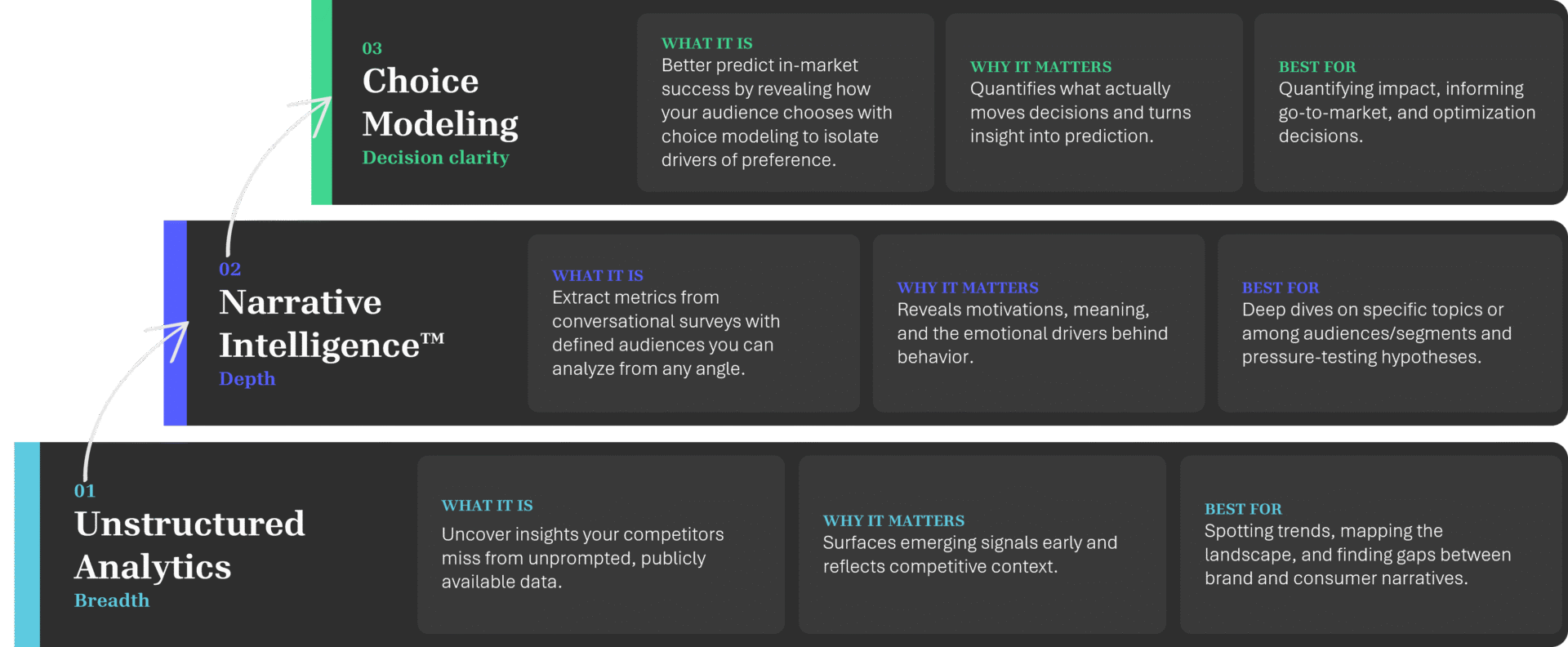
The three-layer decision engine
Layer 1: Unstructured Analytics (Capturing the Organic Landscape)
The raw material for making business decisions cannot start with the assumption that we already know the right context. It must begin by looking at the real world through the lens of unstructured data.
To understand how a brand, product, or concept is evaluated, we must first ingest the noisy, unprompted ecosystem where audience decisions are formed and manifest. This means looking at consumer-generated content, media coverage, competitor signaling, and behavior data, and pairing it with the client’s own legacy internal data repositories.
The breakthrough here is not how we get the data, but how we dimensionalize it through the lens of decision science. By processing this chaotic mix of text, images, video, and behavior through customized AI pipelines, we can extract structured dimensions like:
- Cognitive and emotional anchors: Mapping the “hooks” that secure a brand in a consumer’s mind.
- Friction points: Identifying the actual barriers in the user journey.
- Contextual nuances: Decoding complex emotional states, including sarcasm and unprompted brand associations.
By bringing expert, human-guided judgment to this unstructured layer, we transform messy, real-world signals into interpretable metrics that ensure our strategic foundation is both valid and objective.
Layer 2: Narrative Intelligence™ (Bridging Stories and Analytics)
Understanding what is happening in the wild establishes a baseline that requires explanation. We must explain “why.” To do this without falling into the trap of rigid rating scales, you need to use something like Narrative Intelligence™.
People “leak” information when they communicate naturally. It comes through in what they say, what they don’t say, and how they say it. The goal of using conversational AI in surveys is not really to get colorful qualitative quotes or to run fast, cheap qualitative research. The actual revolution of AI in this space is what we do with the narrative data once captured.
We must treat the conversational front-end as a superior, unpolluted, unstructured data source from which we can derive quantifiable variables. By deploying dynamic AI probes in the moment, we allow consumers to describe their experiences, choices, and barriers in their own natural vocabulary in rich, engaging ways.
This next step is the most essential. We apply analytical frameworks to transform these organic narratives into structured, quantifiable dimensions. These cannot be mere themes, but the very dimensions we care about: likelihood to purchase or recommend, brand attributes, and emotional connections. We can measure constructs like “inspiration,” “nostalgia,” or “brand leadership” as they naturally occur in free thought, turning them into robust explanatory variables for predictive modeling.
Note that this is well beyond coding or themes. The use of these alone or primarily is lazy, and does not permit the more powerful statistical modeling that leads to confident decisions. We cannot be satisfied with “qualitative” summaries. Important decisions require serious effort, not qualitative opinions or simple theme counts.
A valuable part of this approach is that you build into the process the ability to discover unexpected variables. This removes the pressure on the researcher to anticipate every causal potential at the start. If an executive develops a new hypothesis three months later, we don’t need to field a new study. We can re-dimensionalize the existing narrative database along the themes. We can also enlist AI agents to help us discover themes and potential causal relationships that we missed. This is the use of AI that improves research and end decisions, not just makes it cheaper to do what has been done.
Layer 3: Choice Modeling (Behavioral Validation and Experimental Control)
An understanding of environmental context and narrative drivers is necessary, but it is not sufficient unless it is anchored in behavior. Decisions fundamentally require tradeoffs. At some point, a consumer must choose one option over another given real-world constraints like price, product features, availability, and brand. If you do not measure and model that friction, you do not understand what levers really drive behavior.
This is where the experimental control of choice modeling becomes indispensable. We replace “soft” survey data with behavioral validation.
By building Guided and Integrated Discrete Choice Models (DCMs) and MaxDiffs, we create dynamic, living tools rather than static, one-and-done reports. These systems allow decision-makers to add variables, test messaging variations, and simulate market shifts over time without the massive time and capital expenditure of launching entirely new studies. Whether mapping product feature utility against consumer delight (a choice-based Kano approach) or utilizing machine learning pipelines to optimize share-of-choice simulations. Done properly, AI should be infused where it makes the process better and thus the decision-maker smarter, not just where it is trendy.
The power of the connected engine
Unstructured data analysis, Narrative Intelligence™, and discrete choice modeling alone are valuable tools. Stopping with one or doing them in isolation creates difficulties for decision makers. When these layers are connected, they create a loop of continual improvement:
- Variables discovered in the unstructured data wilds inform the conversational design of the Narrative Intelligence™ probes.
- The resulting narrative dimensions feed, profile, and explain the choice engines.
- The behavioral tradeoffs mapped in the choice engines validate the real-world impact of the organic trends discovered in the wild.
This systematic approach moves us from what is happening (the landscape) to why it is happening (the narrative dimension) to what will drive the final choice (the validation).
The path forward for decision experts
The goal of market research is not just “insight.” Insight has become another commoditized concept the industry uses to excuse run-of-the-mill, descriptive research. We need to be more pragmatically focused than that.
The real goal is valid, high-conviction decisions. Shifting our focus from passive measurement to active decision science bridges the gap between understanding behavior and executing business strategy.
At PSB Insights, this is the machinery we build every day. We align our methodology, our technology, and our consultative expertise to match the choices our clients face. We don’t just want to make you smarter; we want to give you the empirical conviction to make your next major strategic move. That is what it means to move past the taglines. That is what it means to be decision experts.
Let’s talk about how you and your customers make decisions. Get in touch with me—robkphd@psbinsights.com